Wednesday, 8 August 2007

'Lost' stones of Fauld...

For years as I have driven along this road 15miles to the north, these huge white stones have intrigued me. They look so out of place and I have always wondered how they got there.... My investigations led me 3 miles away to this sign. Most English footpath signs point to such places as, 'Dingleberry Bottom' or 'Weston-under-Lizard', you know normal villages with normal names.
This one is different. In fact it's probably the only one in the country....I hope!

Another sign you don't see everyday.


This is the crater left by the biggest unnatural explosion anywhere on Earth until Hiroshima!


At 11.00 am, 27th November 1944, 4000 tons of high explosive blew up. A mushroom cloud 50 yards wide and upwards out of sight, threw out mounds of earth and rock up to a ton in weight and scattered debris for up to 11 miles away. The crater left was 400ft deep, 1/4 mile in diameter and covered an area of 12 acres. Afterwards the surrounding area was covered with a fine dust 4 inches deep, quietening footsteps and creating a moonscape. The blast was heard in London and recorded in Geneva as an earthquake.


Below these hills was a gypsum (a white rock used for making plaster) mine, which was being used as an arms dump. A vast amount of high explosive were stored as the build up to the Normandy invasion. As well as being a dump, bombs were repaired here. Returning bomber aircraft would drop any remaining bombs into soft marshland, they would be recovered and fixed at this site. It is thought that it was while work was being done on one of these, coupled that many of the bombs were stored ready armed ready for use that the tragedy happened. 70 lives were lost, 18 bodies were never recovered. Upper Castle Hayes farm, with all its buildings, wagons, cattle and people completely disappeared.
Thankfully, there wasn't a sympathetic explosion and the majority of the dump didn't explode, but even so buildings many miles away were damaged and the top of Fauld hill was removed from the skyline. The countryside was littered with live ordnance, Mills bombs, land mines, anti-personnel, detonators and 4000lb bombs. Rescues in the mine took 3 months due to pockets of gas, 10,000 tons of rubble and 6 million gallons of water from the nearby reservoir. One search party reported finding a cow standing in a field, twice its normal size, bloated with air from the shock wave. They tried to put it out of its misery by shooting it, but it failed to fall. On closer inspection it was found to be already dead, the angle of its legs holding it in the upright.


For many years the truth of what had happened here was not disclosed. Kids used to play in the bomb hole, rolling rocks down its steep sides. It was not until recently that the area was fenced off and signs erected. In 1974 it was revealed that the explosion was caused by "bombs being taken out of store- primed for use and replaced unused, with detonators still installed." There is some speculation that it was actually caused by the impact of a German V-2 rocket. Parts of a fin similar to that on the V-2 were found. The V-2 rocket entered service in January 1944, it was the worlds first ballistic missile reaching a height of 55 miles before returning at supersonic speed and impacting at 1,780mph. The theory says that this is why there wasn't a 'sympathetic' explosion, as most of the stored bombs were displaced from the mine before they exploded. Many of the successful V-2 attacks were kept secret by the goverment in order to not demoralise the population or allow the Germans to calibrate their aim.


In the fields around the site are many of these war time buildings. They seem to be old shafts, now capped, many of them with signs of large calibre gun emplacements.


It is apparent that these mine workings are still in use and are quite extensive. I found this ventilation shaft relating to it some 2.5 miles away.


I couldn't quite see in, even using the camera held up high. A small pebble dropped in revealed an almost bottomless pit! Who knows what secrets it hides....


Monday, 6 August 2007

See things in a different light......

You may know that as well as seeing in normal light, most digital cameras can see far more... In fact they can see well into the infra red band of the spectrum, and this is where the fun begins. In order for the camera to pick up the infra red you have to filter out the rest of the visible spectrum. You can buy infra red pass filters but they're rather expensive. Here is a cheaper way...
First see if your camera can see infra red. To do this, switch it on and point a TV remote at the lens, press and hold one of the remote buttons. You won't be able to see the light, but if your camera can then your half way there. Next, sort out your old photos, or more exactly the negatives, remember those, before all this electrickery gadgetry digital malarky? Now, what you're looking for is the bits at the end of the negatives, the spare bit that has no image on it but has been exposed and developed. It should appear dark reddy brown. Transparent bits are no good.

You need enough of this stuff to cover the lens, and you need three to four layers. Clip them together or tape them at the edges and then attach them to the lens in such a way that no light can get in around the edges (you'll have to figure this bit out by yourself).


I used a camcorder for these photos, which are better suited for this because they are biased towards being able to film in low light etc, while digital stills cameras specialise in good depth of colour and so often filter infra red out in order to maintain a correct colour balance. To combat this, either take your camera apart and remove the cyan correction filter (only do this if you have an old camera that you don't mind ruining, as inevitably you are left with a matchbox full of spare bits that no longer want to go back....all modern cameras are assembled by minute elves, this is the only way to make them so small), or set to 'low light' / 'night shot' etc.


Eyes look spooky under infra red vision!


Best results are achieved on a bright sunny day. It won't work when it's dull, cos there's barely enough light for the camera to operate with. You may need to manually adjust the focus as well.


If anyone has any success with this I would love to see you post the results.


Many insects and particularly bees can detect infra red, this is why they are sometimes attracted to what at first glance seems like a rather plain flower, but under infra red often display patterns you wouldn't know were there.


Open water shows up inky black. Use a polarising filter (if your camera can cope with even less light!) and you will be able to cut the reflection and film fish which shine brightly!
Some car windows have special layers on them to block sunlight and they show up opaque black.


Finally, a warning... Humans reflect infra red and so show up light. Some types of clothes don't reflect infra red so appear invisible. In some circumstances your camera will work like X-ray specs!!! Might seem to good to be true, but BEWARE..When Great Aunt Flo comes to visit wearing her new light summer dress you could see a sight that no mere mortal was meant to see........my eyes!!!


Friday, 3 August 2007

The Ups and Downs of Derbyshire....

With all the recent flooding, I decided that perhaps somewhere high up might be more suitable for a day trip. The Derbyshire Dales seemed the ideal choice. We headed for the Peak District National park about 40 miles north. Great roads on the way up which zig zag through the countryside. We arrived at the village of Wetton, high up above the Dove Dale valley. Parking was complicated by a stubborn chicken that kept on insisting on running into the space every time I made a move, it was eventually lured away with a piece of pork pie. We decided to head towards Thors cave. There was a footpath but as always we wandered off as the next field always seems more interesting. It wasn't long until we found ourselves in the middle of a field of what we hoped were friendly cows. One cow was particularly curious, and came over. She was a gentle chap/ chappess and so we distracted her with an apple so that we wouldn't be followed down the steep slope.

We could see the headland of Thors cave in the distance and making our way over to it managed to rejoin the path.


The cave entrance is sloped and you have to scrabble to get in. It's not the deepest of caves, but we came prepared with head torches so that we could explore. We managed to get to the far back, and even with torches it was difficult to see your footing. It was cold, windy and a little bit creepy as this was the site of a Bronze age burial.


Back in the light we took some photos. I briefly considered taking this alternative exit until I looked down and realised how the ground dropped away abruptly.


Our boots were now wet which made the way out quite perilous. The slope wasn't that steep but it had been worn smooth by thousands of feet over the years, and beyond the slope was a very steep drop that I was keen to avoid!


It didn't help that all the handholds were worn smooth too.


This photo was taken halfway down to the valley floor where there was a natural break in the Hazel coppices and you could glimpse a view of the cave above. It seems hard to believe that this headland was formed under a warm shallow sea somewhere south of the equator.

We made it down onto the path in the Manifold valley. The path is actually the old route of the Leek and Manifold Light railway which used to bring tourists to the region in Victorian days. The River Manifold runs alongside the path and curiously disappears below ground in certain stretches only to magically reappear further on.

The path was OK but a little too easy and anyhow we needed to get back and it wasn't heading the right way. There was an enticing hillside to our right and it didn't look too steep, we thought we'd give it a go. The plan was to get to the top, walk along the ridge and circle round to the village. It started off as a gentle slope but soon we were climbing on all fours!...


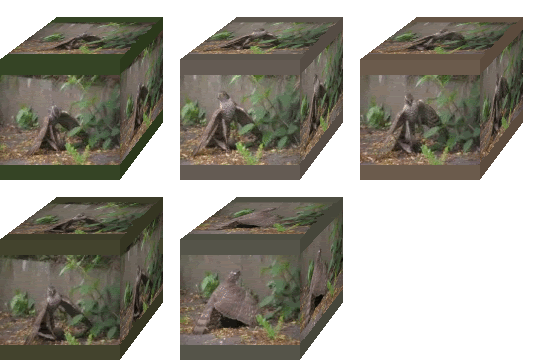
I began to think we might have underestimated things a bit when the birds of prey we had seen wheeling overhead were now alongside. The hillside got more and more vertical, but "just keep three points of contact and I'll be fine" I kept telling myself. Quickly I snatched a pic of the bird alongside me and then, I looked down... Suddenly I felt the need to have four points of contact and stopped moving. Frozen there for a while I eventually decided that I was more up than down and had better just get on with it.


It got really windy as we approached the top, which made me dig my fingernails in all the more. I was soooo glad to be at the top looking down on the Falcons, or Kites (never did figure out which they were).


The view of Thors cave from the top was spectacular. Most of the hard slogging done, it was a relatively easy walk back to the car. The chicken was being called in for its tea from the neighbouring farmhouse, that sounded like a good idea so we headed off....


Wednesday, 1 August 2007

Scamp by name, scamp by nature....

I'd arrive home late at night, pausing for a while listening to something on 'Talk' radio often I would hear a plaintiff little (((meooww))). Scamp had seen the car and had come across the gardens from where he lived to say hello. When I opened the door he'd hop on in, have a bit of an explore and a fuss, before settling down on the rear parcel shelf to have a wash.
I always felt obliged to stay a while as he'd made the effort to come and see me even if it was raining or cold. One day he stopped coming....


I later heard from his owner that he'd turned up late one evening with most of his tail missing and minus one leg! The vet had found teeth marks on the bone. Scamp had had a terrible time and was lucky to be alive. His owner thought he might not make a full recovery and wouldn't be able to be let out again. Months past and I didn't see Scamp....


Today there was a ginger and white ball of fluff up by the cold frame, it was Scamps favourite spot, he could keep an eye on the bird table and any arrivals by car from this lookout. As I approached, a cat skulked in the bushes, nervous at my advance. I called his name, a pause, a quick shake and then an athletic leap onto the lawn. Only three legs and no tail wasn't going to hold Scamp back as he bounded down the lawn. He was his good old self, smarming around and rolling over wanting his tummy tickled. Welcome back Scamp, always fluffy in the face of adversity....


Thursday, 26 July 2007

"There's no such thing as a free lunch".....

Well I beg to differ, and I'll have to prove it cos I've left my lunch and my coffee flask at home!

A good way into my walk and it dawns on me why my rucksack is lighter than usual. Those lovely sandwiches and that flask of 'camp' coffee is still sitting on the counter in the kitchen. I do however, have my small compact brew kit with me. This consists of a good sized titanium mug, and inside, a small meths burner, lighter, folding spoon, knife and some meths. I've got a bottle of water with me, so I'm all set for a free lunch!

First off, a nice hot drink. Heat your water, chop up some pine needles, pop them in and let steep for a while. What can I say? It's hot, and piney! To be fair I'm rather missing my camp coffee. Apparently pine tea is very high in vitamin C. I don't know about that, but it's brought the cup up nice and clean!

There's lots of way to prepare free food, but when you've only got one pot/ cup then a soup/ stew/ pottage is your best option. I need to make a stock so that it isn't just a cup of water with some leaves floating around in it. This is 'cat tail' (Typha spp) and it is quite versatile. The root contains loads of starch, roast it on a fire and then suck the white fibres inside (spit them out afterwards). I'm going to peel and cut them boil in the water a bit then squeeze them out leaving a nice starchy, potatoey stock. At the base of the leaves where they join the root is a tight section of green. This can be stir fried, but I'm going to slice it like leeks and add it to the pot.


Next, stinging nettle. The tops are the most tender. Tear them up roughly with the back of the knife, once cooked they lose their stinginess, honest! You can use these when cooking at home, boil in stock, drain, mash, add a dab of butter and serve like spinach.(Nice on toast!) A basic soup can be made , prepare as above, but leave in stock, reduce slightly then add cream.


Under the Beech trees, I found some Ground Elder. Most people think this is a weed and it can be a nuisance in gardens as it grows so quickly. It was introduced into Britain by the Romans as a vegetable but has lost favour due to its invasive qualities...in the 1500's John Gerard wrote complaining that, "Once taken roote, it will hardly be gotten out again, spoiling and getting every yeere more ground, to the annoying of better herbes". I know what he means, but if it's a pest in your garden my recommendation is to eat it!


Dandelion, most plants with white sap are to be avoided as they are often poisonous, this is one of the exceptions. You can make a coffee substitute with the dried and roasted roots (used during the world wars when normal coffee was unavailable), but this is a lengthy process and I was happy..issh with my pine tea. The leaves can be used in salads, they are often a little bitter and it is better to use the young ones or cover the plant for a few days so that it turns pale and becomes milder. I'm putting only a couple of leaves in as they have the side effect of making you want to take a leak!


Nasturtium isn't strictly a wild plant, this one was poking through onto the tow path from someones garden, so I counted it as wild. Hot and peppery the leaves make a good salad plant and will also add a herb effect to my 'cup' lunch. The flowers are edible too, (great for decorating salads) I'll add a few bits for colour.


Hawthorn hedges are everywhere. In spring when the buds are just beginning to open is the best time to pick but any time of the year is OK if you use the smaller tender leaves. Really good with cheese sandwiches. It is too early to use the berries, in autumn when they are red you can simmer them with a few crab apples and make a nice Hawthorn jelly to go with Lamb.


There is lots of green and peppery flavours in the cup, now for a bit of garlic. In spring I would use wild garlic (often found in Bluebell woods), this time of year though 'Jack-by-the-hedge' , 'garlic mustard' or 'hedge garlic' as it is called is a good alternative. Not such a strong taste as wild garlic but very nice on sandwiches and in cooking. This one is a bit ropey looking, but I'm hungry.


This is a brilliant plant...Fat-hen. Silly name, but a truly delicious to eat. The leaves cook like spinach, the stems taste like asparagus and the seeds can be used to thicken soups and stews. It can even be eaten raw. Once you recognise it, you'll realise that it grows everywhere, especially on disturbed ground by fields, tracks, building sites and the corners of gardens. It has a long growing season and as long as you don't pull it up by the roots it will continue to grow providing yet more food. It has often been relied upon in times of famine, either as a crop in its own right or as fodder for cattle and hens, hence the name. Since Anglo-Saxon times it was important enough to have villages named after it. In old English it was called 'Melde', there is 'Milden' in Suffolk and 'Melbourn' in Cambridgeshire. This is the final ingredient to my 'pottage'.

A quick simmer, and it's looking...very green! Tastes alright, a bit bitter could do with salt, not as good as sandwiches, but then it was free!


Stomach satisfied, but a slight tangy, bitter, peppery aftertaste. What's for pudding?

Handfuls of Blackberries and.....


.....some choice wild strawberries. Who said there was no such thing as a free lunch?....


Wednesday, 25 July 2007

Tagged!....

I've been tagged by 'Secret Agent' , it's a "Five things" MeMe. So, here goes.....


Five things I was doing 10 years ago.


1) Worrying about what I would be doing in ten years time.


2)Driving way too fast down country lanes in the dead of night with the spotlights ablaze.


3) Thinking I was getting old.


4) Sleeping in a wood in mid winter on a protest camp against the new toll motorway.


5) Enjoying getting out of chairs without grunting and eating what I liked without getting fat.


Favourite snack food.


1) Bacon sandwiches with tomato ketchup. Preferably while camping or kayaking.


2) Chips (UK) with salt and vinegar from a proper chip shop.


3) 'Peperami'.


4) Pork scratchings.


5) Scotch egg.


Five things I would do if I were a millionaire.


1) Buy land, put a covenant on it so that it can never be built on, plant a forest and, smile.


2) Pack a hammock, sleeping bag and cashpoint card. Start walking, see what happens...


3) Make sure the bloke who lives rough by the canal is alright.


4) Buy land in Greenland. With all this global warming, it's the next property hot spot (you heard it here first!).


5) Buy a jet pack.


Five songs I know all the lyrics to.


1) Zoolook by Jean Michelle Jarre.


2) Cars by Gary Numan.


3) 'Billy, don't be a hero', don't know who it was by. It was about a soldier going off to war and being told by his fiance not to be a hero 'come back and make me a wife'.


4) 'Jewelled' by 'Propaganda'. Always remember this as it was played on the opening titles of the rally report on BBC. Yes, I know, most of these are instrumentals, but I can hum them perfectly!


5) Can't remember anymore titles let alone the lyrics.


Five bad habits. (only 5?!)


1) Driving way too fast down country lanes in the dead of night, with spotlights ablaze.


2) Unpredictable and sudden bouts of grumpiness.


3) Videoing everything....if it's not on video it probably didn't happen.


4) Ignoring signs; 'slow down', 'keep out', 'quicksand', 'weir', 'bull in field', 'MOD property', 'deep excavations'.


5) Ignoring good advice....who'd have thought it, motorbikes are dangerous!


Five things I like to do.


1) Drive way too fast down country lanes in the dead of night, with spotlights ablaze.


2) Skim stones.


3) Play the keyboard so badly, and so loud that the cats run away and the koi hide at the far end of the aquarium.


4) Camping in Wales......or anywhere.


5) BBQ with friends.


Five things I will never wear again.


1) Lucky pants (underwear)...you can push your luck too far.


2) Size 'small'....why did I worry about being skinny? (Good old days!)


3) A frown....'don't worry, be happy!'


4) Ill fitting swimming trunks. When I got out of the pool, they didn't.


5) A uniform. School uniform was the bane of my life. Never again will I be bullied into wearing anything so uncomfortable. Nowadays it's cotton or nothing, you don't want me to answer the door to you on a 'polyester' day!!

So, I have to name five people....

Lesley.

Elisa.

Blue the spa girl.

Angela Marie.

Photogirl.

Please don't feel obliged, I know some of you have been tagged previously or might not want to be bothered and that's fine by me.